
From Training Request to Performance Problem
Step 1 / 6·Don't accept every training request
0/6 steps done
Learning objectives — after this module you will:
- Distinguish a training request from a performance problem
- Write the performance gap as Expected − Actual
- Diagnose the cause with the Skill – Will – System model
- Write the running-case diagnosis to the Blueprint
Don't accept every training request
Understand why a training request is a symptom, not a diagnosis.
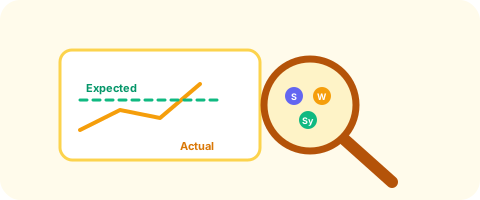
A training request is what someone else ASKS FOR ("run a Communication Skills course"). A performance problem is what's actually HAPPENING at work. Taking a request and running a class immediately is like a doctor prescribing on the patient's request — sometimes right, usually wasteful.
The starting formula for any diagnosis: Performance Gap = Expected Performance − Actual Performance. Writing both sides specifically puts you ahead of 80% of failed training projects.
Expected Performance
Hiệu suất kỳ vọng
Actual Performance
Hiệu suất thực tế
= Performance Gap
Khoảng cách cần thu hẹp — điểm xuất phát của mọi giải pháp đào tạo
Before / After: how to describe the problem
Before (training request)
“The team needs to learn Communication Skills.”
It's a pre-guessed solution, not saying who, what behavior, or what consequence. You can't design or measure from this sentence.
After (performance problem)
“Frontline Managers aren't giving clear, timely feedback, leading to recurring errors and reduced employee initiative.”
It states the audience, the specific missing behavior, and the business consequence — verifiable, designable and measurable.
Key takeaway: Performance Gap = Expected − Actual. Describe the specific gap before discussing solutions.