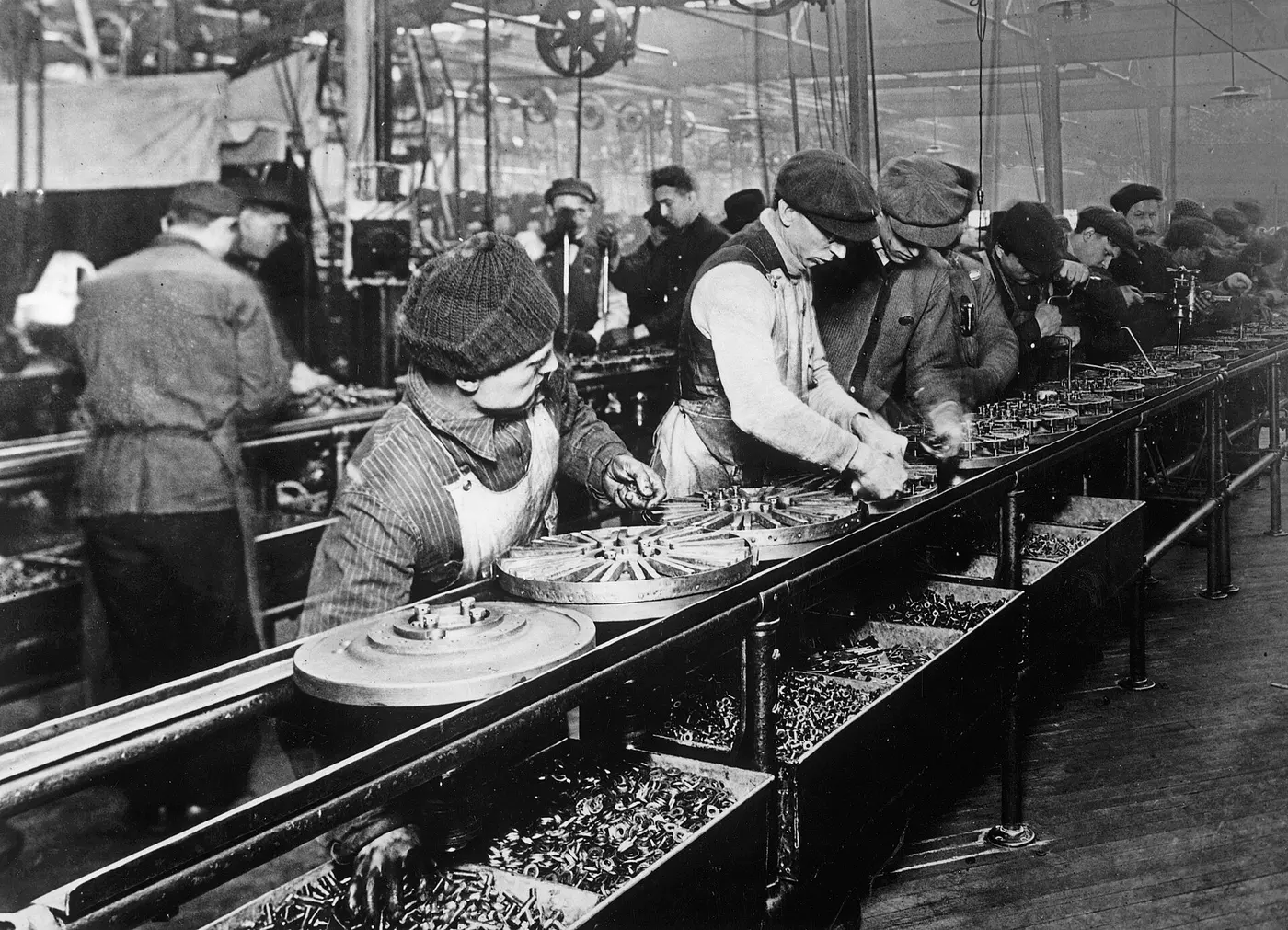
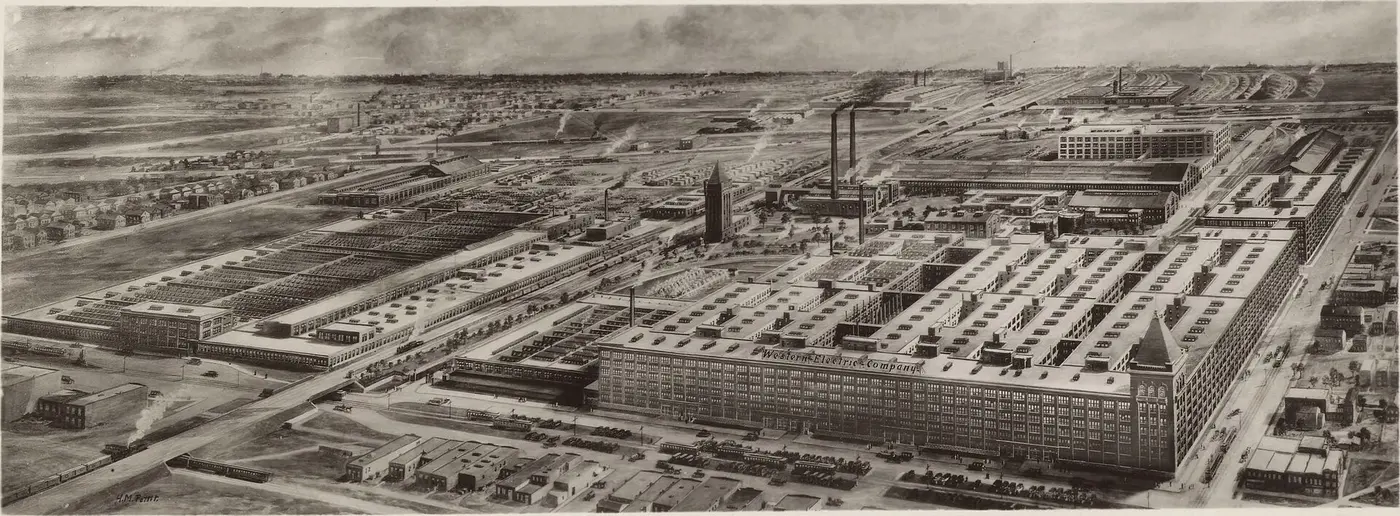
In November 1924, in Cicero on the edge of Chicago, two Western Electric engineers started changing the lights in three telephone relay assembly departments. They were working with a committee of the US National Research Council, whose honorary chairman was a famous name: Thomas Edison1.
The question was narrow and practical. Does better lighting make workers produce more? The Hawthorne plant was one of the most advanced factories in America, employing around 35,000 people, mostly first- and second-generation immigrants, making equipment for AT&T1. The electrical industry was keen on scientific proof that would sell more power and more bulbs.
The story everyone was told
The textbook version goes like this. Every time the researchers changed the lighting, productivity rose. Brighter light, higher output. Dimmer light, still higher output. At the end they turned the lights down almost to darkness and the workers still produced more. The conclusion: what made people work harder was not the light but the feeling of being watched.
From 1928 Western Electric brought in academics, most prominently Elton Mayo of Harvard. The new team moved six women relay assemblers into a separate room, varied their breaks, meals and hours, and recorded output mechanically2. Output rose clearly. Mayo concluded the six had become a team, and that team spirit, decent supervision and informal relationships were what drove productivity2.
Together the two sets of experiments produced the "Hawthorne effect": people change their behaviour because they know they are being observed. It went into textbooks in psychology, sociology and management. In 1982 the bestseller In Search of Excellence was still telling readers that attention to employees, not working conditions, had the dominant effect on productivity1.
There was one small problem. Nobody had ever analysed the lighting data.
The "lost" data
The final report on the lighting experiments was never written. Researchers believed the raw data had been destroyed, and every account relied on a few paragraphs in a 1927 trade journal1. One historian even suggested why: the results pointed to a standard of only 7 to 10 foot-candles, which would hardly have pleased the electrical industry1.
Steven Levitt and John List, economists at the University of Chicago, went looking. They traced records for one department to a microfiche room in a small library in Milwaukee. Records for the other two sat in a forgotten archive in Boston1. For the first time in more than 80 years, the numbers were coded and run through statistics.
What the data said
The first detail is almost mundane. Every lighting change happened on a Monday, because Sunday was the only day the plant was closed and electricians needed it to rearrange the lamps1.
Output at Hawthorne had a strong weekly rhythm: lowest on Saturday, then up again on Monday compared with Saturday. Levitt and List set Mondays with a lighting change next to Mondays with no change at all. The two lines were virtually identical1. The "immediate response" retold for decades turned out to be the start of the working week.
The drops in output when experiments paused also had another explanation. They fell in summer, when there was enough daylight that the researchers stopped intervening, and they happened in rooms no longer in the experiment as well1. That was seasonality, not disappointment at no longer being watched. In one period, a room that had left the experiment still improved substantially, with nobody changing its lights.
The authors wrote bluntly that the celebrated data patterns were "entirely fictional"1. To be fair, they did find faint signals: output responded more to artificial light the experimenters controlled than to natural light, and in one specification output was 3 to 4 percent higher while experiments were running. Add tighter controls and that figure disappears1.
The ending the books leave out
The relay test room experiments ran until June 1932. The Depression had led to one American telephone in ten being disconnected and an 80 percent fall in Western Electric's profits. The women in the test room were given notice. Jennie Sirchio, the fastest of them, was kept on in the office for a few months before she too was let go1.
The experiment about the power of attention ended with layoff letters. That detail rarely makes it onto a slide.
Why HR should care
Hawthorne is not just history. Every year, HR and learning teams present dozens of results of the "after the programme, productivity rose 12 percent" kind. Many of them share the structure of the Hawthorne story: measure before and after, no comparison group, no allowance for seasonality, and retold so often that nobody asks any more.
A team leader programme launched in March at a garment factory will almost certainly "show" higher output than the first two months of the year, because those are the Tet month and the month workers drift back slowly. Nothing is wrong with the programme. The measurement is simply answering a different question.
Levitt and List's lesson goes beyond method. The idea that attention helps people perform may well be true to a degree, and later research supports it in subtler ways. The unsettling part is that a whole field believed it for eighty years on the strength of data nobody had opened.