
Vietnam's digital economy and digital society programme for 2026 to 2030 aims to train more than three million workers and develop 100,000 digital technology enterprises. The backdrop is stated plainly: the share of workers with a recognised qualification remains low, while demand for digital and technical talent far outstrips supply1.
Earlier, on 21 September 2024, Deputy Prime Minister Le Thanh Long signed Decision 1017/QD-TTg on developing human resources for the semiconductor industry. The 2030 targets are at least 50,000 engineers and staff with a bachelor's degree or higher across every stage of the semiconductor value chain, at least 5,000 people with deep expertise in artificial intelligence serving the industry, and 1,300 lecturers given intensive semiconductor training2.
The figure of 1,300 lecturers is easy to skim past. It is the most important one, and a story from Ho Chi Minh City explains why.
The largest plant, and where to find the people
On 29 October 2010 Intel officially opened its chip assembly and test plant at Saigon Hi-Tech Park in Ho Chi Minh City. The initial investment was a billion dollars, the floor area 46,000 square metres, about five and a half football pitches. According to Intel, it was the largest assembly and test factory in the company's global manufacturing network3.
A plant like that needs thousands of skilled engineers and technicians. Intel saw strong potential in Vietnam's workforce, but concluded that sustaining high-tech manufacturing would require better engineering education at source, in the universities. It partnered with the US Agency for International Development and Arizona State University to do that3.

Training the teachers first
The programme was launched in 2010 as the Higher Engineering Education Alliance Program, HEEAP, funded by USAID and Intel Vietnam, with Arizona State University's Ira A. Fulton Schools of Engineering as the main delivery partner4.
The difference lay in who it trained. HEEAP did not focus on training workers for the plant. It trained lecturers at engineering universities and colleges, both in Arizona and in Vietnam, in teaching methods tied to practice and to what industry actually needed4.
Over roughly nine years, from 2010 to 2019, with total investment of about 10 million dollars, the programme trained more than 5,300 faculty members, awarded more than 400 vocational scholarships to women, and convened an annual engineering education conference of more than 400 leaders4.
The logic is clear. Train an engineer and a company gets one engineer. Train a lecturer and every year dozens more engineers are taught the new way, for years on end.
Lessons for the 50,000 target
Decision 1017 already sets a target of 1,300 intensively trained lecturers, along with four national-level laboratories and laboratories at eight public universities2. The HEEAP experience suggests that target will decide the quality of the other 50,000.
For employers there is a further layer. As millions more people enter the market with basic digital training, competitive advantage shifts from hiring someone who knows the tools to shortening the time before a newcomer produces results. That is an onboarding and on-the-job training problem, not only a recruiting one.
And as with Intel in 2010, any company that needs deep technical talent will have to take part in producing it: working with colleges, sending its own engineers to teach, and opening its plant to student placements.
Not only engineers
The 50,000 figure makes people think of chip design engineers. In reality a semiconductor value chain needs several layers of people: design engineers, process engineers, technicians who run and maintain equipment, quality inspectors. An assembly and test plant like Intel's in Ho Chi Minh City needs a great many people in those middle layers.
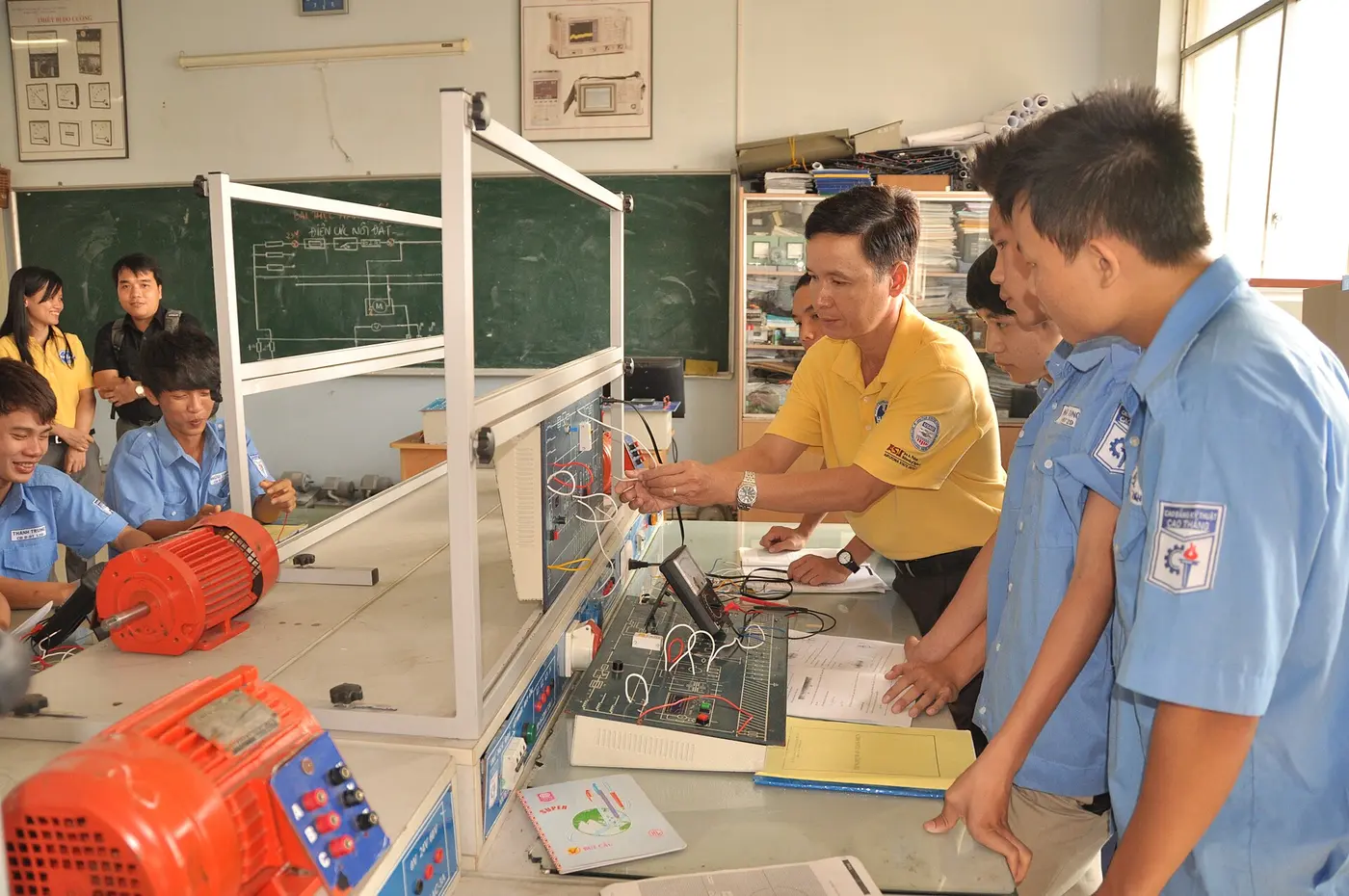
HEEAP did not ignore them either. Alongside university lecturers it worked with technical colleges such as Cao Thang, and awarded more than 400 vocational scholarships to women, a group historically under-represented in engineering4.

For HR teams in electronics, semiconductors or supporting industries, this means workforce plans need to cover roles without "engineer" in the title. Without skilled technicians, a plant full of good engineers still cannot run at capacity.